My earlier post, Sipping with Purpose: AVIVO’s Regenerative White & Rosé, focused on the intersection of farming, climate, and wine—how thoughtful agricultural choices can influence both what grows in the vineyard and what ends up in the glass. This follow-up takes that conversation further with a look at AVIVO Red, and with a deeper exploration of the philosophy behind the wines.
After tasting the wine, I had the opportunity to engage in a thoughtful Q&A with Ridgely Evers, the guiding force behind both AVIVO and DaVero Farms and Winery. What emerged was not simply a discussion about wine, but about leadership, restraint, and the long view—ideas that resonate far beyond any single bottle.
To better understand how those ideas translate from philosophy to practice, I asked Ridgely Evers a series of questions about AVIVO’s origins, its Mediterranean focus, and how regenerative farming shapes decisions both in the vineyard and in the cellar.
The Vision Behind AVIVO
Q: AVIVO has such a distinctive identity—rooted in regenerative and organic farming, yet deeply Italian in inspiration. What was the original spark that led you to create the brand?
A: I was deeply influenced by the very first Earth Day (when I was still in high school), and have practiced regenerative farming (both organic and Biodynamic) for decades, fueled by my embracing the old proverb, “We inherit the land from our parents, and borrow it from our children.”
Q: You’ve long championed Mediterranean grape varieties that thrive in California’s climate. What drew you to those varieties, and how do they reflect your broader vision for AVIVO?
A: It’s pretty simple, actually: I started not from the question of “how do we make the best Chardonnay?” but rather “What are the best varieties to grow here?” California’s climate maps perfectly to the Mediterranean, and especially to the Italian peninsula from Liguria down to Campania. (While I also love the wines of France, the growing climate in Bordeaux and Burgundy bears no resemblance to ours.)
Philosophy: Farming with Intention
Q: You approach farming as something larger than just growing grapes—it’s about soil health, climate, biodiversity, and people. How does that broader view shape the decisions you make at AVIVO and DaVero?
A: I once spoke at my business school reunion and said, “Being a Biodynamic farmer has done more to make me a good CEO than the other way around.” The big ideal in Biodynamics is the focus on the farm as a living organism, and the health of that whole rather than the crop. The things we do in our farming stem directly—and daily—from that premise.
Q: The term regenerative has gained momentum in the wine world, but it’s often misunderstood. How do you define regenerative farming at AVIVO, and what practices do you feel make the biggest difference in soil health and vitality?
A: It’s not one or two things, but rather a continuously evolving system. Humans naturally tend toward reductive thinking, but we resist that temptation, focusing instead on the whole organism, and are in a constant dialog as to what we can do to make the farms stronger and more vital every season.
Q: DaVero and AVIVO have both gone beyond organic certification to embrace biodynamic and regenerative principles. What motivated you to take that next step, and what has the transition taught you?
A: Organic, as practiced in the U.S., is simply a thou-shalt-and-shalt-not checklist that is applied uniformly regardless of what you’re farming or where. It has value, of course, but leaves so much outside as a consequence of the one-size-fits-all mandate of the NOP.
Many of the ideas Ridgely Evers shares here—about farming as a living organism and resisting reductive thinking—echo the regenerative and climate-aware approach that first drew me to AVIVO’s wines.
Choosing Partners and Thinking Long-Term
Q: AVIVO sources fruit from vineyards across California. How do you choose grower partners, and what qualities or farming philosophies do you look for when building those relationships?
A: There is no substitute for face-to-face, feet-on-the-ground assessment. The farming partners with whom we work share our values, which are apparent in the way they talk, how they ask and answer questions, and the feel of their soil and the look of their farm.
Q: Regenerative agriculture requires long-term commitment and collaboration. How do you inspire others—growers, team members, and consumers—to think regeneratively?
A: I’ve yet to meet a farmer who doesn’t want to take care of their land. But they have to be risk-averse, because farming is a risky business. So we try to share what we’ve learned not just about the practices we follow, but about the economics that result.
A Note on Sagrantino and Restraint
During the Wine Writers Education Tour Sonoma, I had the opportunity to visit DaVero and taste Sagrantino—a variety known as much for its formidable tannins as for its longevity.
Q: I remember tasting a Sagrantino from DaVero about a decade ago that was quite tannic, but a recent vintage felt more balanced and refined. How has your approach evolved over time?
A: Sagrantino is, to my knowledge, the most tannic grape on the planet, and requires considerable ageing. What we didn’t understand back then was that fruit tannins are very different from wood tannins (the latter actually fight food). So since the 2012 harvest, none of our wines—not just Sagrantino—has ever encountered anything but neutral oak barrels.
It’s a telling answer, and one that mirrors the broader AVIVO philosophy: restraint, transparency, and an emphasis on how wines behave at the table.
Disclosure: The AVIVO Red referenced in this article was provided as a media sample. No compensation was received, and all opinions expressed are my own.
Tasting the 2021 AVIVO Red
Tasting AVIVO Red felt like a natural extension of that earlier AVIVO tasting—less about novelty, and more about how farming philosophy translates directly into the glass.
The organic grapes are sourced from Ledbetter Family Vineyards in Lodi, CA. The vineyards are farmed regeneratively (Certified Regenerative, and in-transition to Demeter Certified Biodynamic) without the use of glyphosates (RoundUp) or other pre- and post-emergents. In fact, AVIVO is one of just three American wine brands certified to be glyphosate-free. In addition, AVIVO uses lightweight bottles, corks made from recycled ocean-bound plastics.
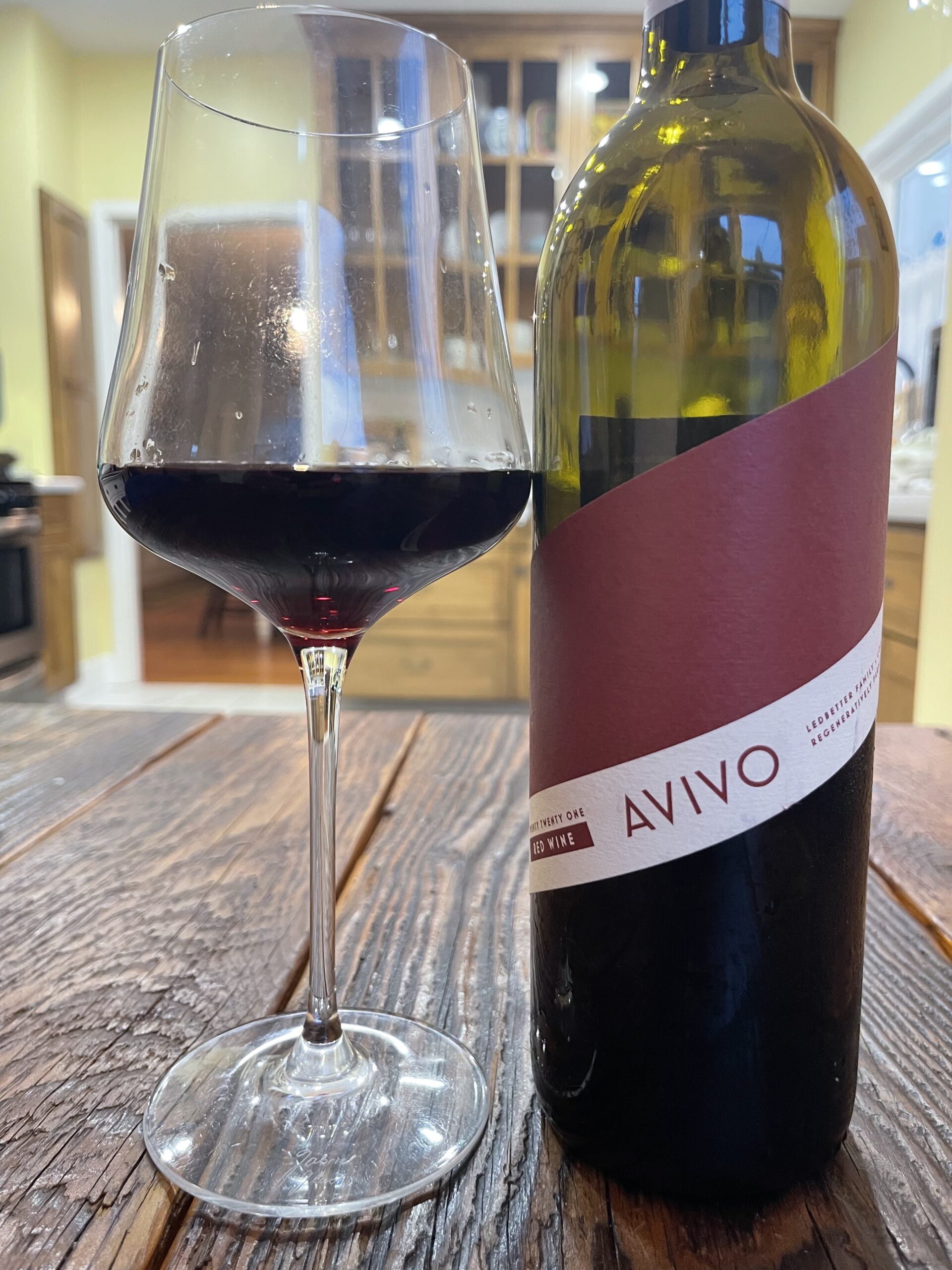
Tasting note: Medium ruby in color, with aromas of sour cherry, strawberry, dried laurel bay, and wet clay. On the palate, the wine is medium-bodied, showing juicy, mouthwatering acidity and soft tannins. Flavors of sour cherry and strawberry are accented by a savory, food-friendly note. Medium-plus finish.
Blend: 95% Sangiovese, 5% Syrah (Ledbetter Family Vineyards, Lodi)
14.1% ABV | SRP $22.50| 90pts
Connection to Place and Purpose
Q: You’ve said before that great wine starts with healthy soil. When you taste an AVIVO wine, what are you hoping people sense about the place it comes from?
A: What I hope people feel about AVIVO wines is their purity: they are beautifully clean, naturally. Because of that, each of our wines is truly a time capsule of that variety, in that vineyard, that year—deliciously different with each vintage but always reflective of place.
Looking Ahead
Q: What’s next for AVIVO and DaVero Farms? Are there particular grape varieties, vineyard initiatives, or sustainability projects you’re especially excited about in the coming years?
A: I’m convinced that we’re only scratching the surface today. Both companies are committed to continuously experimenting, learning, and actively sharing our successes and our failures—both agricultural and financial.
Final Thoughts
True to their name—AVIVO means “Alive” in Italian—these wines brim with vitality. They are delicious, refreshing, and food-friendly, crafted to shine at the table while honoring the land that produced them. That sense of integrity extends beyond the vineyard: each bottle is made without additives, added colors, or sugars, and clearly lists ingredients and nutrition facts on the label. At $22.50 a bottle, the AVIVO red delivers not just quality and value, but a level of transparency that reinforces trust—wines that feel as alive and honest as the principles behind them.
Good interview. You might enjoy my NZ Māori view on sustainable viticulture down in little NZ: https://www.wineinsights.org/2658935_new-zealand-at-the-forefront-of-sustainable-viticulture